Book: The Selfish Gene Author: Richard Dawkins
Translator: Zhao Shumiao
Ever since I read«上帝錯覺>
, I’ve been completely blown away by Dawkins’s command of English and his unique insights.After that, I didn’t dare read any more of his books in English until I heard Lao Gao mention this one«自私的基因>
. That’s when I decided to get the Chinese translation. I never expected that a book published over 30 years ago would still be so eye-opening. The book has 11 chapters, but I only plan to discuss a few sections that I found particularly mind-blowing when I first read them, and I’ll try to explain them in my own words to see if I’ve understood them correctly.As the author of this review is neither an evolutionary biologist nor a genetics expert, I can only interpret the material from the perspective of a general science student. Please feel free to correct any errors.
Chapter 5: Aggressive Behavior
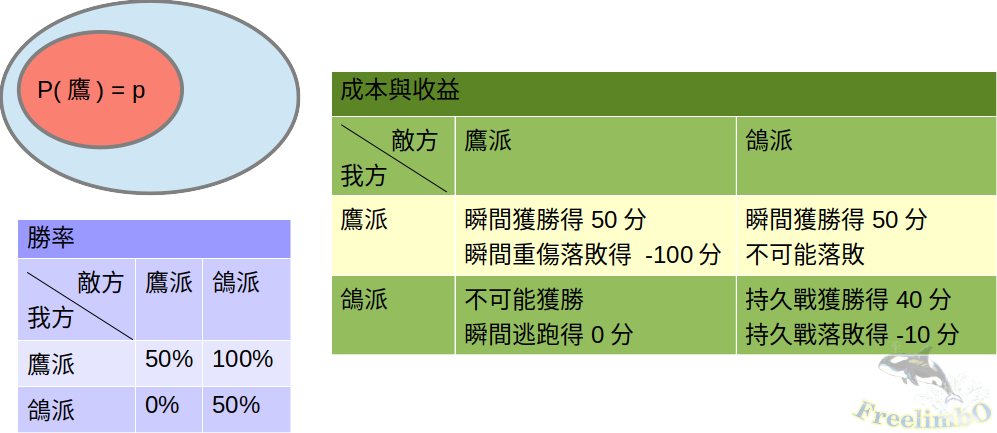
The first part that struck me as fascinating was Dawkins’ explanation of Evolutionarily Stable Strategies (ESS).He uses the “hawk” and “dove” strategies to explain aggressive behavior. This example demonstrates how ESS calculates the expected value of a strategy through simple posterior probability calculations, then compares the expected payoffs of the two strategies; the one with the higher payoff will increase its proportion within the population. Interestingly, however, the result is that both sides develop countermeasures, leading to a dynamic equilibrium.
|
| Hawk vs. Dove |
As shown in the figure above, the most important factors in the Hawk-Dove game are cost, probability, and payoff. These rules can be represented using a Venn diagram, where the proportions of Hawks and Doves in the population are denoted as $p:(1-p)$, which also represents the probability of encountering an opponent.Next is the probability of winning. When two hawks fight, the outcome is decided instantly; the win rate is 50%, but the loser suffers severe damage and is defeated. When two doves encounter each other, they engage in a protracted standoff to intimidate the opponent; neither is injured, but regardless of the outcome, both are penalized for the time spent.If a Hawk encounters a Dove, the Dove will immediately forfeit the match.
|
| Expected Payoff of the Hawk Strategy |
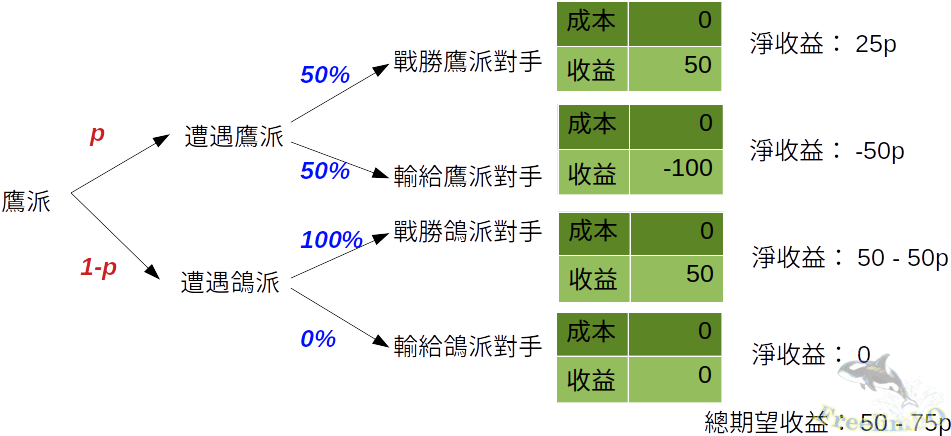
Thus, we can calculate the expected payoff by simply and brute-forcing all possible scenarios a Hawk might encounter. We simply multiply the probabilities on each branch, then multiply the result by the sum of the cost and payoff to obtain the net payoff.Summing the net payoffs of all terminal branches yields a total score for the hawks of $50–75p$. This clearly exhibits a negative growth trend relative to the proportion of hawks in the population: as the number of hawks increases, individuals carrying hawkish genes will find it increasingly difficult to profit easily within the population.
|
| Expected Payoff of the Dove Strategy |
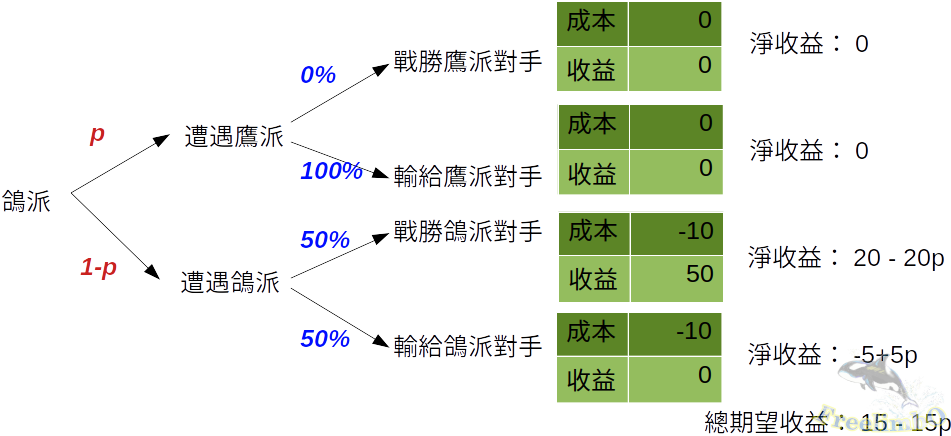
Similarly, the expected value of the Dove strategy can be derived by exhaustively analyzing this tree diagram; we obtain $15-15p$.
According to ESS, we need to compare the expected payoffs of both strategies to determine which is superior. Here, we find that the Hawk strategy has an advantage when the following inequality holds: $$ 50-75p \gt 15-15p $$
Simplifying slightly, we find that the hawkish strategy has the advantage when $p \lt \frac{7}{12}$; conversely, when $p \gt \frac{7}{12}$, the dovish strategy regains the advantage.This conclusion is not one that can be easily reached without calculation at the outset; it is surprising that the hawk and dove strategies can actually achieve a $7:5$ dynamic equilibrium.Explained with the benefit of hindsight, the doves always preserve themselves during combat. Although their expected payoff in a pure-dove scenario ($p = 0$) is lower than that of the hawks—who burst in suddenly and are invincible—and they can never defeat the hawks in a single battle,their expected payoff exhibits a relatively mild negative growth relative to the opponent’s population proportion, while simultaneously growing positively with their own population proportion. This prevents the doves from being completely wiped out.
Chapter 9: The Battle of the Sexes
Building on Chapter 5, which used ESS to explore invasion strategies, this chapter expands the complexity of the problem to two populations, each with two strategies. By calculating the proportions of these four strategies, we see that they can also reach an interesting equilibrium within the populations.
|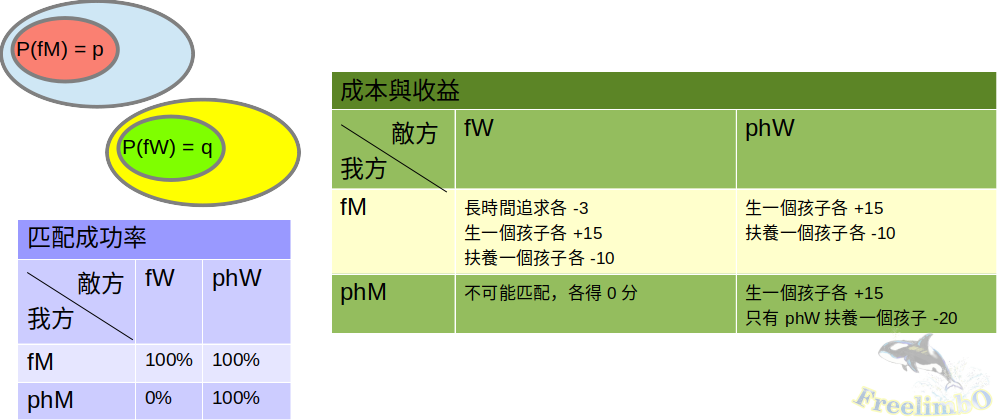
| Faithful Male, Philanderer Male, Strict Female, Open Female |
In this instance, the two populations are males and females, each with two distinct strategies: among males, there is the “faithful” strategy, characterized by loyalty that withstands tests, and the “Philanderer” strategy, characterized by promiscuity and a refusal to take responsibility. Females similarly have these two strategies. Here, we abbreviate the four strategies as fM, phM, fW, and phW to represent the faithful male, the philanderer, the strict female, and the open female, respectively.At this point, the win rate should be redefined as the success rate of forming a pair, and the cost-benefit analysis should be broken down into scores for raising children.
|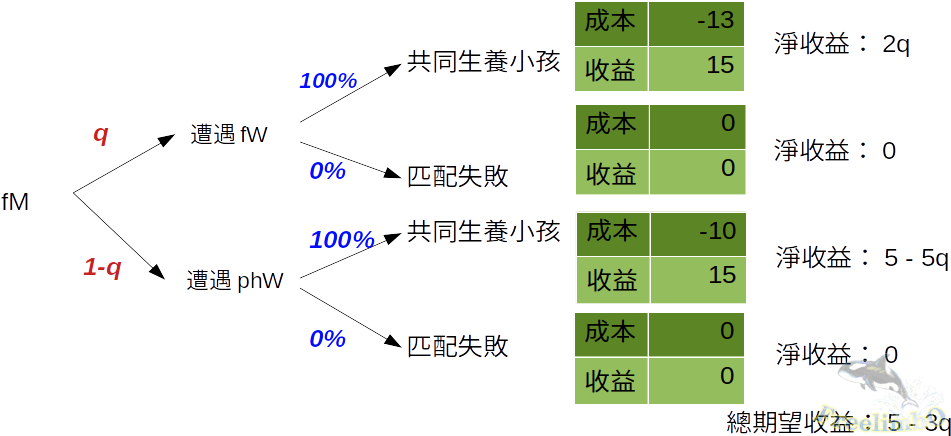
| Faithful Male |
Next, we exhaustively list all possible scenarios a faithful male might encounter, as we did earlier, and calculate the net benefit at the terminal nodes. Summing all possibilities yields an expected benefit of $5-3q$, where $q$ is the proportion of strict women among all women.
|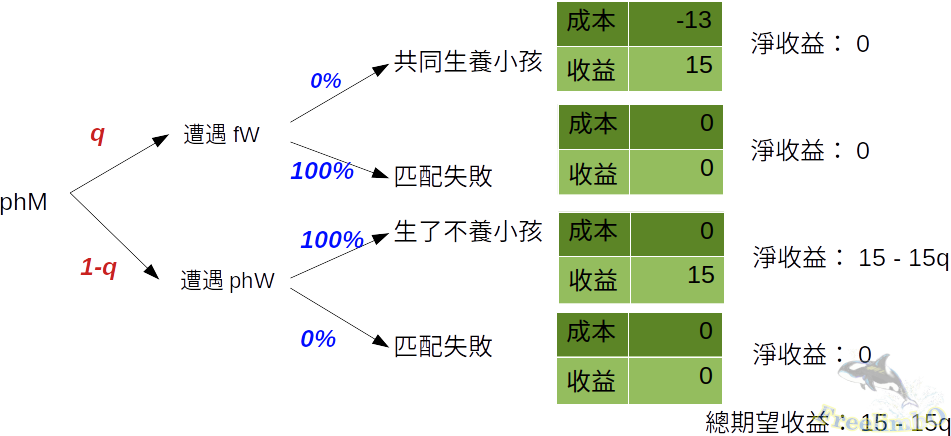
| Bad Boy |
The various scenarios for the bad boy can also be enumerated, yielding $15-15q$. This indicates that if there are no strict women in the female population, the bad boy will gain the strongest advantage.
|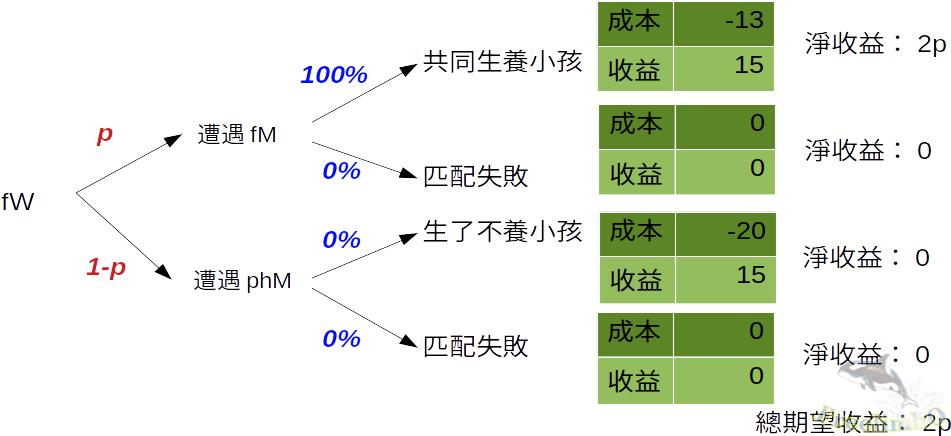
| Strict Women |
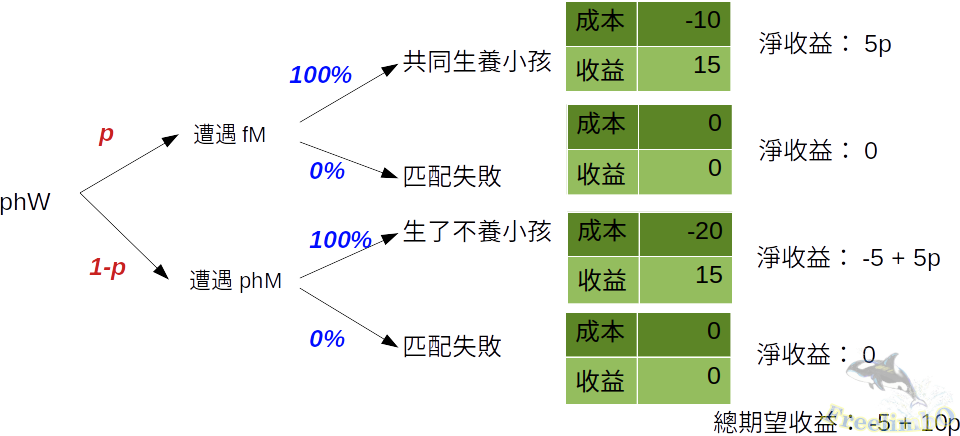
Strict women require a lengthy courtship before agreeing to start a family with a partner. This condition naturally weeds out unfaithful men who lack the patience to invest, but the net payoff here appears somewhat meager.
|
| Open Women |
Open women do not require a lengthy courtship and readily form families with men.It’s important to note that if she bears a child with a bad guy, his departure will force the open woman to shoulder double the emotional burden of raising the child.
With the expected payoffs for the four strategies in hand, we can compare which one holds the advantage within each group. The honest man has the advantage when $5-3q \gt 15-15q$.Strict women, on the other hand, have an advantage when $2p \gt -5 + 10p$.
After simplification, we find that honest men have an advantage when strict women make up more than $\frac{5}{6}$ of the population, while strict women have an advantage when honest men make up less than $\frac{5}{8}$ of the population.As a strategy gains an advantage, its proportion within the population gradually increases.
|
| The four strategies check and balance each other |
Thus, a dynamic equilibrium among the four strategies is established. For example, if the system has reached a ratio of $5:3$ between honest men and scoundrels, and a ratio of $5:1$, any further increase in the proportion of “honest men” will cause the proportion of “open women” to rise as well, while the proportion of “strict women” will be suppressed and decrease. With no one to check the “playboys,” their proportion within the male population will increase, thereby squeezing out the “honest men.“This completes a feedback loop. Readers can choose any point to begin their reasoning and will discover that the system’s dynamic equilibrium always returns to the ratios mentioned earlier; no single strategy can completely eliminate another.
Dawkins also noted that this probabilistic behavior may not be distinguishable at the individual level; it could even apply to a single man, who might exhibit the “good guy” strategy $\frac{5}{8}$ of the time and act like a total jerk the remaining $\frac{3}{8}$ of the time. This is because the genes of “bad guys” may have, through long-term evolution, become mixed into all of our chromosomes. Any resemblance to mathematical models is purely coincidental.
Chapter 10: You Scratch My Back, I’ll Ride on Your Head
What shocked me the most was the collapse of the image I’d been fed since childhood that “bees and ants are hardworking.”I had always believed that queen bees and queen ants, reigning high above and ruling their entire colonies, exuded a sense of nobility, while the worker bees and ants under their rule toiled tirelessly and selflessly, sacrificing themselves one after another for the greater good of the colony. But in this chapter, Dawkins actually uses genetic evidence to debunk this fairy tale.
|
|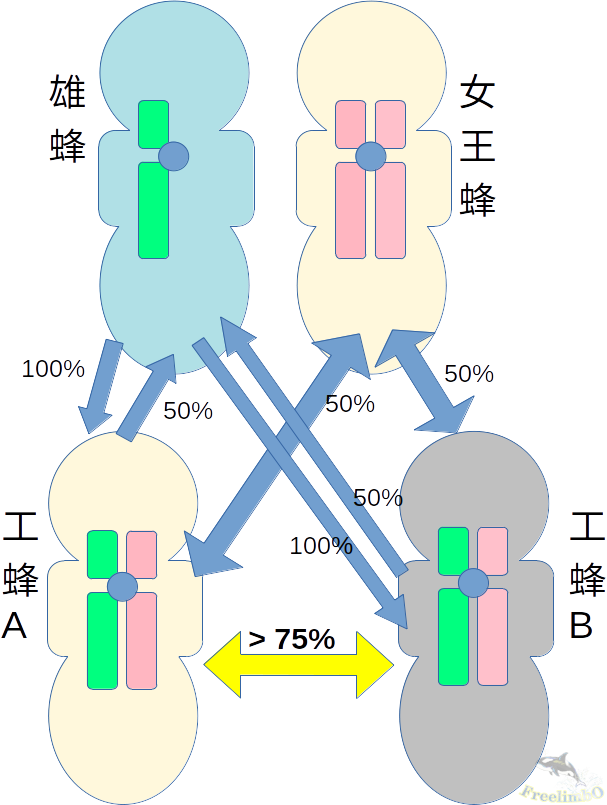
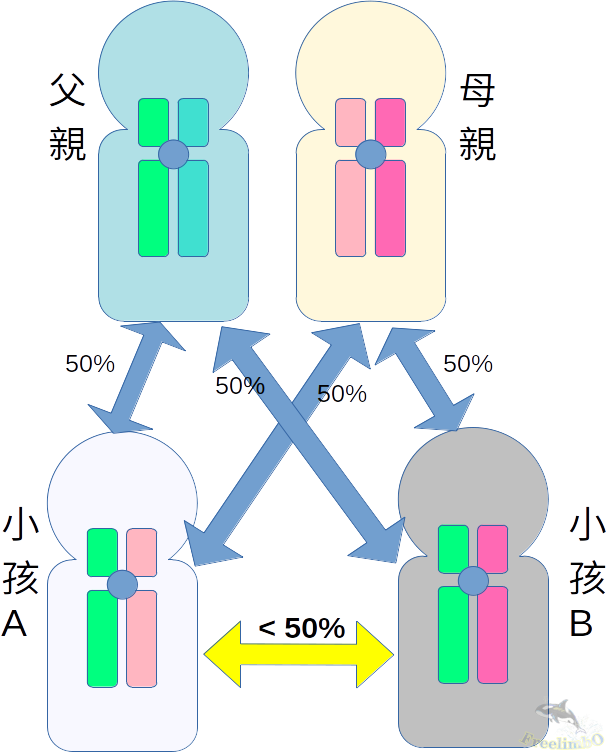
| Genetic similarity between human siblings: 50% | Genetic similarity among Hymenoptera worker bees: 75% |
As shown in the figure above left, the genetic similarity between human siblings is only 50%, a figure derived by summing the 50% from each parent. However, Hymenoptera insects have a unique characteristic: if an unfertilized egg carries only half of an unpaired chromosome, it will develop into a male.Since worker bees born to a drone and a queen possess paired chromosomes, they are all female. In this case, summing the similarity from both parental lines yields $50% \times 100% + 50% \times 50% = 75%$. At first glance, I thought this simply meant that the similarity among bee siblings was slightly higher than that among human siblings.However, when we examine the similarity between the queen bee and the worker bees more closely, we discover that the mother-daughter pair shares only 50% similarity—far less than the similarity between worker bees themselves!
This suggests a chilling truth: the worker bees care for the queen bee with meticulous devotion and labor tirelessly to sustain the hive’s metabolism—not because they are subjugated by the queen’s authority or are born to toil, but because they know that by preserving the queen’s life, their genes will be replicated, achieving genetic immortality.What a cheap and efficient way to do things! It saves them the trouble of finding a mate, spares them the time and energy of reproduction, and ensures that the new eggs are closer to clones of themselves. The queen bee is nothing more than a reproductive machine for the worker bees.
Some of the other perspectives in the book have already made their way into textbooks, while others are concepts we’ve absorbed through daily life. Nevertheless, Dawkins’ detailed explanations are well worth reading. I highly recommend this excellent book—it’s not at all dry, and even has a bit of a bite to it.